How a Diving Course School Educates Young Divers for Lifelong Ocean Confidence
There is a distinct difference between learning to swim and learning to dive. While swimming is often viewed as a recreational skill or a safety necessity, diving introduces a completely new dimension of physics, physiology, and environmental awareness. When parents look for a Diving Course School Educate Young Diver, they are not just signing their children up for an underwater hobby; they are investing in a structured educational framework that builds discipline, situational awareness, and respect for the natural world.
The concept of a specialized school dedicated to young divers goes far beyond basic certification. It involves a holistic approach where technical skills are taught alongside character development. In these environments, the water becomes a classroom where mistakes have immediate, tangible consequences, teaching accountability in a way that traditional land-based schooling rarely can.
Beyond the Bubble: Real-World Applications of Early Dive Training
Many adults assume that scuba diving is purely a vacation activity, reserved for tropical holidays. However, the skills acquired through a rigorous youth diving program have profound real-world applications. The ability to remain calm under pressure, manage limited resources (like air supply), and communicate non-verbally are transferable skills that benefit young people in academic, social, and future professional settings.
Consider the scenario of a teenager participating in a marine biology field study. A student who has undergone proper dive training can focus on data collection rather than struggling with buoyancy or equipment management. This competence allows them to engage deeply with scientific observation, contributing to conservation efforts rather than just observing them from a boat. Similarly, in emergency response training, the breath control and panic management techniques learned in diving courses are invaluable for lifeguards, coast guard auxiliaries, and future first responders.
For families who travel frequently, having certified young divers opens up a world of interactive tourism. Instead of passive sightseeing, these families can explore coral reefs, shipwrecks, and underwater caves together. This shared experience fosters stronger family bonds and creates memories rooted in adventure and mutual trust. The Diving Course School Educate Young Diver model ensures that these experiences are safe, sustainable, and educational, turning every dive into a lesson in geography, biology, and history.
Who Benefits Most from Specialized Youth Dive Programs?
While any child with an interest in the water can benefit, certain groups find particular value in structured diving education. Understanding who these programs serve helps parents and educators make informed decisions about enrollment.
- Anxious or Overthinkers: Children who struggle with anxiety often find solace in the rhythmic breathing required for diving. The forced mindfulness of monitoring depth, air, and surroundings can be therapeutic, providing a mental reset from the chaos of daily life.
- Kinesthetic Learners: Students who struggle in traditional lecture-based classrooms often thrive in the hands-on environment of dive training. The immediate feedback loop of adjusting buoyancy or clearing a mask appeals to those who learn by doing.
- Future STEM Professionals: For kids interested in engineering, physics, or marine science, diving offers a practical laboratory. Understanding pressure differentials, gas laws, and fluid dynamics becomes intuitive rather than abstract.
- Teams and Clubs: Swim teams and water polo clubs often use dive training to improve overall water confidence and breath-holding capabilities, giving athletes a competitive edge in endurance and comfort in the water.
The Role of Visual Learning and Digital Resources
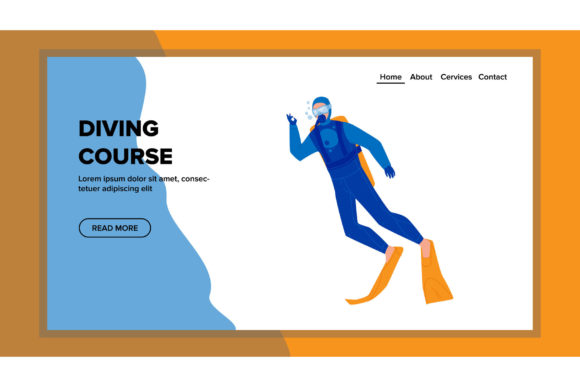
Modern dive education relies heavily on visual aids to explain complex concepts. This is where resources like the Diving Course School Educate Young Diver Vector illustrations become crucial. These digital assets, available in formats such as JPG, EPS, AI, PSD, and PNG, are not just decorative; they are functional teaching tools.
Instructors use flat cartoon illustrations of characters wearing professional costumes and accessories to break down intimidating procedures. For example, a vector graphic showing a diver checking their gauges simplifies the pre-dive safety check into a memorable visual sequence. These images help young learners visualize the correct posture, equipment placement, and hand signals before they ever enter the water.
For content creators and educational platforms, these high-quality vectors allow for the creation of engaging manuals, apps, and interactive modules. The scalability of AI and EPS files means that diagrams can be enlarged for classroom posters or shrunk for mobile app icons without losing clarity. This versatility ensures that the educational message remains consistent across all platforms, reinforcing learning through repeated visual exposure.
Practical Considerations Before Enrolling
Choosing the right diving school is a significant decision. Not all programs are created equal, and parents should look beyond the price tag. Here are key factors to consider when evaluating a Diving Course School Educate Young Diver program:
- Instructor-to-Student Ratio: Young divers require close supervision. A low ratio ensures that instructors can provide personalized feedback and immediate correction of unsafe practices.
- Curriculum Depth: Does the school only teach how to pass the test, or do they teach ocean stewardship? Look for programs that include modules on marine conservation, coral reef protection, and local ecology.
- Equipment Quality and Maintenance: Well-maintained gear is essential for safety and comfort. Ill-fitting or outdated equipment can discourage young divers and pose safety risks.
- Progression Pathways: A good school offers a clear path from beginner to advanced levels, including specialty courses like night diving, underwater photography, or wreck diving, keeping the interest alive as the child grows.
Strengths and Limitations of Early Dive Training
It is important to approach youth diving with a balanced perspective. The strengths are evident: increased physical fitness, improved lung capacity, heightened environmental awareness, and a unique sense of accomplishment. However, there are limitations and risks that must be managed.
Physiologically, young bodies are still developing. While recreational diving is generally safe for children over ten, depth limits and bottom times must be strictly adhered to. Schools that push for deeper dives too quickly are compromising safety for prestige. Additionally, the cost of equipment and certification can be prohibitive for some families. However, many schools offer rental packages and scholarship programs to mitigate this barrier.
Another limitation is the geographical dependency. Access to suitable training sites varies widely. Urban dwellers may need to travel significantly for open water training, which can be logistically challenging. Yet, this inconvenience often adds to the value, turning the training into a series of mini-adventures that broaden the child’s horizons.
Integrating Technology and Tradition
The best modern dive schools blend traditional hands-on instruction with modern technology. Virtual reality simulations, for instance, allow students to practice emergency procedures in a risk-free environment before attempting them in the pool. Meanwhile, digital logging apps help young divers track their progress, fostering a sense of achievement and data literacy.
When selecting a program, look for schools that embrace this hybrid approach. They should use tools like the Diving Course School Educate Young Diver vector graphics to enhance understanding while maintaining the core tradition of mentor-apprentice learning in the water. This combination ensures that young divers are not only technically proficient but also intellectually engaged with the sport.
Ultimately, educating a young diver is about more than teaching them to breathe underwater. It is about cultivating a mindset of curiosity, caution, and respect. Whether through the use of detailed vector illustrations to explain theory or through guided dives that reveal the wonders of the deep, these schools play a pivotal role in shaping the next generation of ocean advocates. For parents seeking to provide their children with a unique blend of physical challenge and intellectual growth, a specialized diving course offers an unparalleled opportunity.